
Machine Learning
Calculus in Machine Learning
This article simplifies core concepts like derivatives, gradients, gradient descent, and optimization using intuitive explanations and real-world examples.

We are continuing the ongoing Mathematics in Machine Learning series, and we’ve been exploring the mathematical foundations that power machine learning. In my previous blog, we learned about how Linear Algebra works in Machine Learning
Now, let’s go a level deeper with the next important concept — Calculus.
Why Does Machine Learning Need Calculus?
Imagine yourself learning something new. Every time you make a mistake, you learn from it, make small adjustments, and try again until you get it right.
Machine learning works in a similar way. A model makes predictions, measures how far they are from the correct answers, and then adjusts itself to perform better.
So, to do this Calculus helps the model answer three important questions:
How big is the mistake?
Which direction should I move to reduce it?
How much should I change?
Without Calculus, a machine learning model would know it’s wrong — but it wouldn’t know how to get better.
What are Functions ?
Before learning Calculus, we need to understand functions.
A function simply takes an input and produces an output.
For example:
Input: Distance Travelled, Speed
Output: Time taken to reach
Or in Machine Learning:
Input: House Features (Sqft., num of bedrooms, Location, Parking, Area)
Output: House Price
The entire goal of Machine Learning is to find a function that maps inputs to outputs as accurately as possible.
Calculus helps us understand how these functions change.
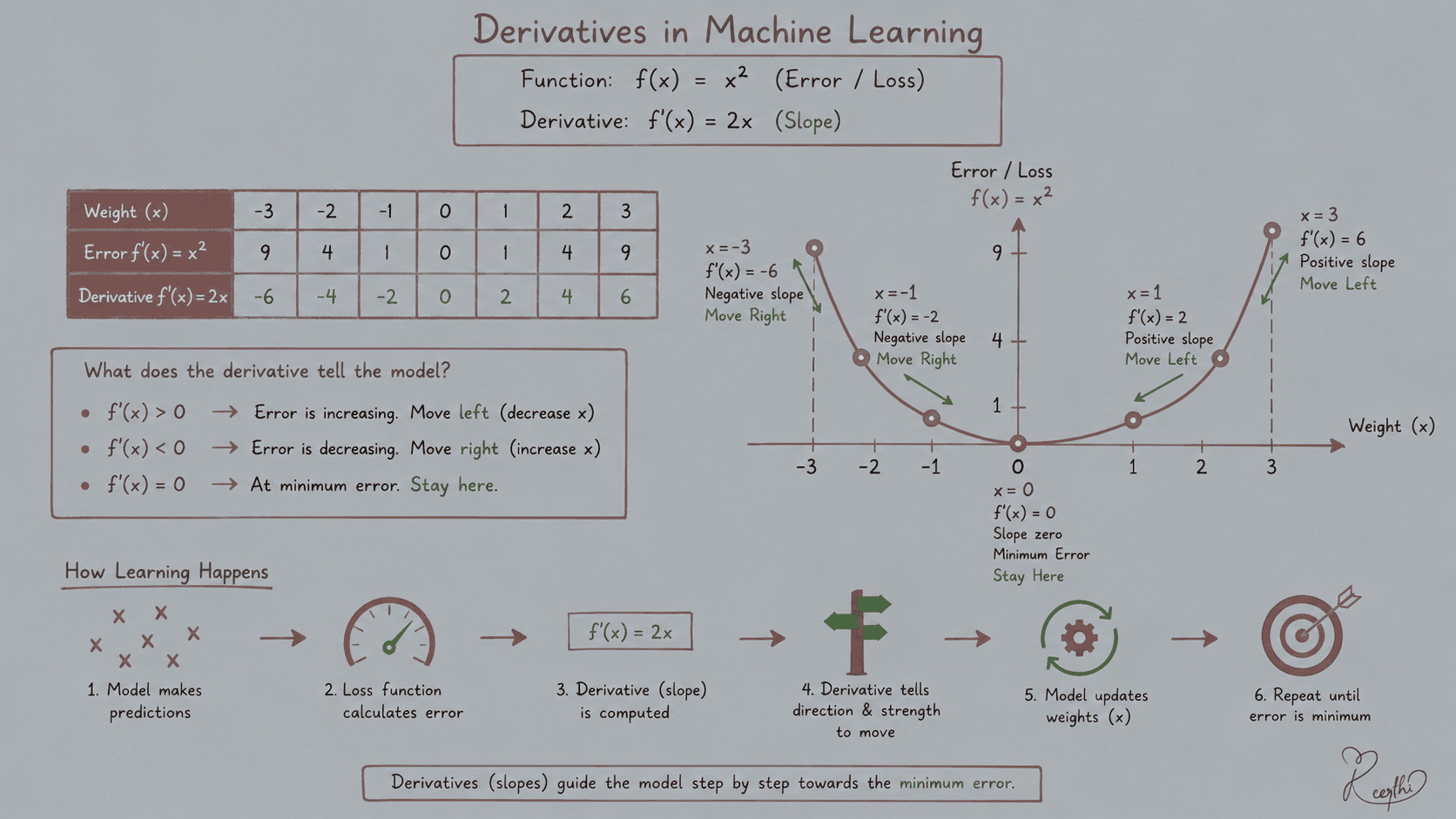
1. Derivatives — Measuring the Change
The most important concept in Calculus for Machine Learning is the Derivative.
A derivative measures:
"How much does the output change when the input changes?"
Now let’s take the example of House Price Prediction , increasing the size of the house by 100 Sqft., increases its price by 5 Lakhs.
Here, the derivative tells us:
“For every small increase in house size, how much does the price increase?”
This idea becomes extremely important when training machine learning models.
In Machine Learning:
Input values change
Model parameters change
Prediction errors change
Press enter or click to view image in full size
2. Slopes and Learning
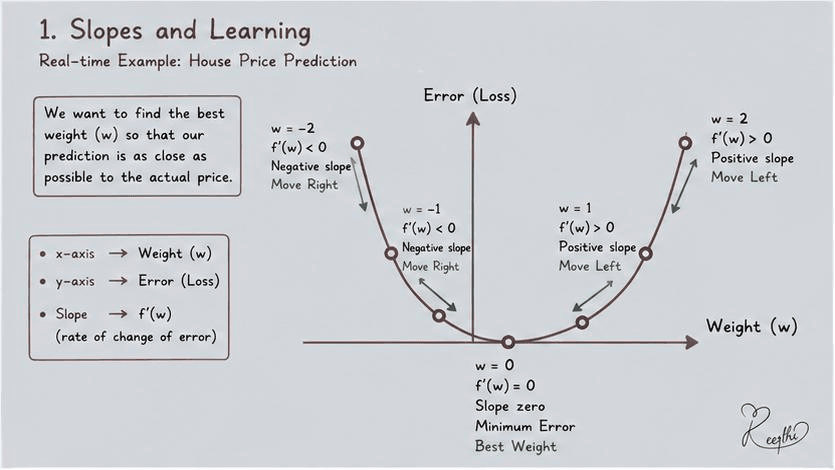
Now we know how much something changes is useful, but ML models need one more piece of information:
Which direction should I move to reduce my mistakes?
This is where the concept of slope comes in.
Because the slope helps us understand whether a model is moving toward a better solution or a worse one. By looking at the slope of the error curve, a machine learning algorithm can decide how to adjust itself to make more accurate predictions.
Think of a mountain. If you’re standing on a steep slope, you know which direction goes downhill.
Machine learning models use derivatives in exactly the same way.
The derivative tells the model:
Whether the error is increasing
Whether the error is decreasing
Which direction leads to smaller errors
This information helps the model move toward better predictions.
3. Cost Functions — Measuring Error
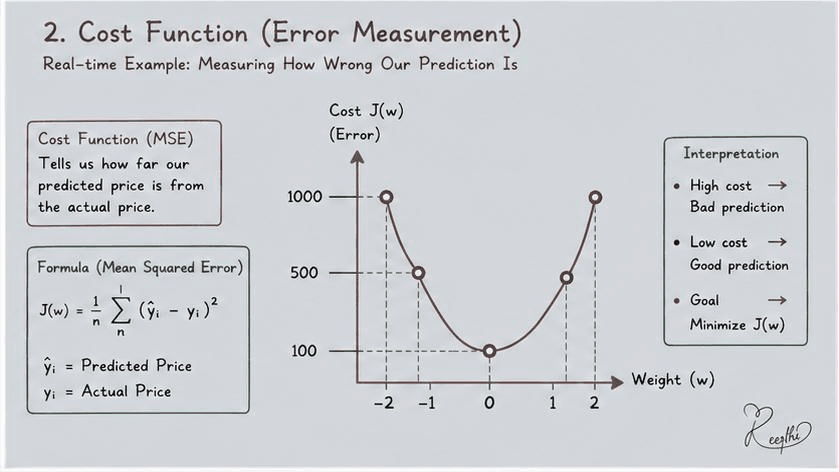
Now that we understand derivatives and how they help reduce errors, there’s an important question to answer first: How does a machine learning model know how much error it has made?
This measurement is called a Cost Function or Loss Function.
Evaluation Metrics include:
Mean Squared Error (MSE)
Mean Absolute Error (MAE)
Cross-Entropy Loss
The cost function produces a number:
Large value → Bad predictions
Small value → Good predictions
The ultimate goal of training is:
Minimize the cost function as much as possible.
4. Gradient — The Direction to Improve
A derivative for a single variable is useful.
But machine learning models often contain hundreds, thousands or even millions of parameters. To handle multiple variables, Calculus uses something called the Gradient.
The gradient tells us:
Which direction increases the error
Which direction decreases the error fastest
Think of standing on a hill while blindfolded. The gradient acts like a guide telling you:
“Walk this way to reach the bottom faster.”
Machine learning models use gradients to find better parameter values.
5. Gradient Descent — The Main Part Behind Learning
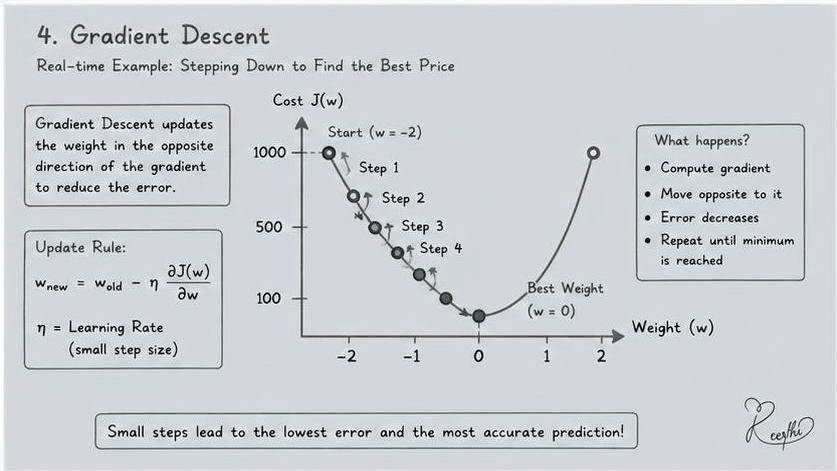
One of the most important algorithms in Machine Learning is Gradient Descent.
It is the process of repeatedly:
Calculate the error
Compute the gradient
Adjust model parameters
Reduce the error
Repeat
This cycle continues until the model reaches a point where the error becomes very small.
Think of a mountain: the Gradient tells you which direction is the steepest uphill walk, while Gradient Descent is the step-by-step strategy you use to walk all the way down to the bottom of the valley.
6. Partial Derivatives
Real-world machine learning models depend on multiple parameters.
For example:
A house price prediction model may depend on:
Area
Number of bedrooms
Location score
Age of the property
Each feature influences the prediction differently.
Partial derivatives help us understand:
“How does the prediction change when only one variable changes while others stay fixed?”
This allows models to optimize many parameters simultaneously.
7. Real Machine Learning Algorithms That Use Calculus
By now, we’ve seen how derivatives, gradients, and optimization help a model learn. But where do these concepts appear in actual Machine Learning algorithms?
Linear Regression
Calculus helps find the best-fit line by minimizing prediction errors. Derivatives and Gradient Descent are used to optimize the model parameters.
Logistic Regression
Used for classification tasks, Logistic Regression relies on calculus to minimize its loss function and improve prediction accuracy.
Support Vector Machines (SVM)
SVMs use optimization techniques based on calculus to find the best decision boundary that separates different classes.
Gradient Boosting Algorithms
Algorithms like XGBoost, LightGBM, and CatBoost use gradients to identify and correct prediction errors, improving model performance with each iteration.
But, whether it’s Linear Regression, Logistic Regression, SVM, or Gradient Boosting, the learning process follows the same idea:
Make Predictions → Calculate Error → Use Calculus to Optimize → Improve Performance
This is why Calculus is considered one of the fundamental mathematical pillars of Machine Learning.
In the next blog, we’ll continue this and look at Probability in ML and see how models use data to make predictions under uncertainty.

